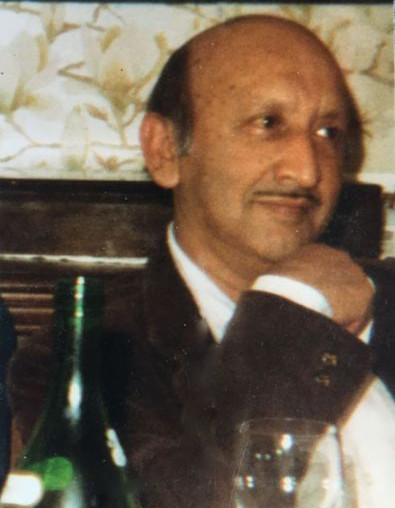
“He was my hero”, said of him his cousin Farouk Dindar upon hearing of Amin's death on January 22, 2006.
Ten days earlier Amin had decided not to seek further treatment after years of illness. He faced approaching death with great courage and abnegation and died quite peacefully at home.
Yes, Amin was a hero in more ways than one but very few people realized it, because he was modest, unassuming and did not wear his heart on his sleeve.
He was born in Krugersdorp, Transvaal, on April 14, 1933, the fourth child and first son of Ismael Bhabha and Khadija, oldest daughter of Mohamed Mamoojee Dadoo, a successful businessman and prominent personality of the town. A few months before Amin's birth, his father abandoned his young family and divorced his wife by letter (an unfortunately legal muslim practice!) This desertion must have left an indelible mark on the child yet to be born. Amin never set eyes on his father for whom he had all his life utter contempt and deep hatred. The cowardice of the father forged the character and personality of the son. In order to survive, deprived as he was from day one of paternal love and guidance, he had to learn very early in life to rely solely on himself.
He was brought up at first by his maternal grand-parents who were kind but failed to see the potential of the boy; after a few years of basic schooling he went to live with his mother and step-father, the latter taking him into his greengrocer's business. When he was not going to the market at dawn or selling vegetables, Amin pursued on his own his secondary education. However, he knew that if he remained in South Africa, he would never go any further.
I cannot imagine worse kharma for an intellectually gifted human being than to be born non-white in apartheid South Africa.
Amin was blessed with an inquisitive and sharp mind, a passion for learning and an exceptional memory; he read voraciously but slowly and remembered everything.
An early influence on his life was his maternal uncle, Yussef Dadoo who, though a brilliant doctor, dedicated his entire life and energies to the anti-apartheid struggle. He soon became a shining example for his young nephew who got involved in the African National Congress.
Having decided that the Law should be his path to fight the evil South African regime and its injustices, and since university education was barred to him in his homeland, at 19 he left South Africa for India, where he enrolled in the University of the Punjab to do his B.A.
The six years he spent there were probably among the happiest of his life. Not only did he acquire an inextinguishable thirst for knowledge and higher learning, but his political savvy bloomed extraordinarily. His analytical mind could grasp the long-term consequences of events beyond the written or the spoken word. He could always read between the lines!
The numerous friends he made in India came from various backgrounds which afforded him an international understanding of world affairs.
He joined the Debating Society of the University and learned the art of debating. He became an excellent public speaker.
In order to earn the money he needed to live and pay his tuition fees, every summer for six years he worked in a hotel in Calcutta. But hardship was not new to him and he always made the best of it.
At 25, with a B.A. in his suitcase, he returned to South Africa where it was evident there was no future for him. So he left again – this time for good – to study law in Amsterdam, Netherlands. After struggling for a while with the language (Dutch is not Afrikaans!) and learning, in six months, enough Latin and French to be admitted into university, he joined the law faculty.
He spent six happy years in A'dam, where he made lifelong friends and indeed came into his own. As well, he became even more deeply involved with the anti-apartheid struggle. As President of the Students' Council, he was invited to take part in debates and speak at conferences, on the radio and even on television. He was quite well-known in intellectual and political circles and earned a reputation as a leftist and a troublemaker.
This proved disastrous when he sat for his finals. One of the professors failed him on purpose – a cruel disappointment!
But Amin was no stranger to adversity and decided to start again, this time in London, England, where he joined the Law Society to study for the Bar, to which he was called in 1970. Probably the proudest moment of his life! But there again, racism and discrimination raised their ugly heads, and because his name was Bhabha and not Barber, he was denied a chance to practise. Another door closed and at 39, he moved to Canada where he had many relatives.
So a new life started in a new country, but his dream of practising law remained unfulfilled. However, his accomplishments, though more humble, were just as important. He informed, influenced and educated many of those who came in contact with him; his years as a teacher were particularly rewarding to him because of his interaction with young people. His knowledge was encyclopaedic, from politics, economics, history, literature to music and the arts. He knew how to listen and had the gift of understanding.
His last years were greatly affected and saddened by ill health but he always kept in close touch with what was happening in the world around him. To his dying day, he never compromised and remained true to his beliefs. He hated with a passion injustice, intolerance and prejudice.
He had the great joy of seeing Madiba become the first black South African president.
All his life he was a man of simple tastes. His only luxuries were reading, learning and drinking innumerable cups of coffee.
His motto was 'High thinking and simple living'.
He was a shining example of purity, courage and modesty. I feel privileged to have shared almost 40 years of life with him.
When I read Amins memoirs of Bram Fisher I can feel his presence next to me.